Trees and the Charlotte Tree Ordinance
By the Tide & Timber Investments team, a veteran-owned residential developer in Charlotte, North Carolina, and an affiliate of Tide & Timber Ventures, LLC. Last updated 21 October 2026.
Quick answer: Charlotte’s tree rules for development are in Article 20 of the Unified Development Ordinance (UDO). For a lot you plan to build on, the big questions are whether there’s a heritage tree (a native tree 30 inches or more in diameter), whether your project counts as a single home or a subdivision, and which frontage trees you’ll have to plant. Check the lot with the City of Charlotte’s Urban Forestry staff before you buy.
Information current as of 21 October 2026, 9:56 PM ET. Rules, fees, maps and market figures change. Anything we could not confirm from an official source has been left out of this article. Check the linked official sources before relying on any detail.
A new house or an ADU, like the ones in Accessory Dwelling Units (ADUs) in Charlotte, needs room, and the trees on a lot can decide how much you get.
For an investor or builder, trees are a due diligence item just like zoning or sewer. A large oak in the wrong spot can move a house, shrink it, add mitigation costs, or in a few cases make a lot not worth buying.
This article explains how the UDO’s tree rules fit together and what to look for on a lot. It’s a summary, as of 21 October 2026. The UDO and the Charlotte Tree Manual are the authority, and they change.
Which tree rules apply in Charlotte?
UDO Article 20, Sections 20.13 to 20.18, covers tree protection. In its own words, it regulates trees on property owned or controlled by the City and on new developments and alterations on private property, inside the city and its extraterritorial jurisdiction (ETJ). Technical detail sits in the Charlotte Tree Manual.
The city may also have tree rules outside the UDO, for example for work that isn’t part of a development project. Ask the city’s Urban Forestry staff which rules apply to your lot and your plans. Outside Charlotte and its ETJ, check that town’s own rules.
When do the development tree rules kick in?
As of 21 October 2026, the UDO’s heritage tree, green area and tree planting rules apply when development results in any of these:
New construction of a principal structure (a new house, for example).
A cumulative increase in built-upon area or building coverage of 5% or 1,000 square feet, whichever is less.
Approval of a standard or minor subdivision.
Grading in anticipation of development counts too. Clearing a lot before you apply for permits doesn’t get you around the rules.
Heritage trees: the one to look for first
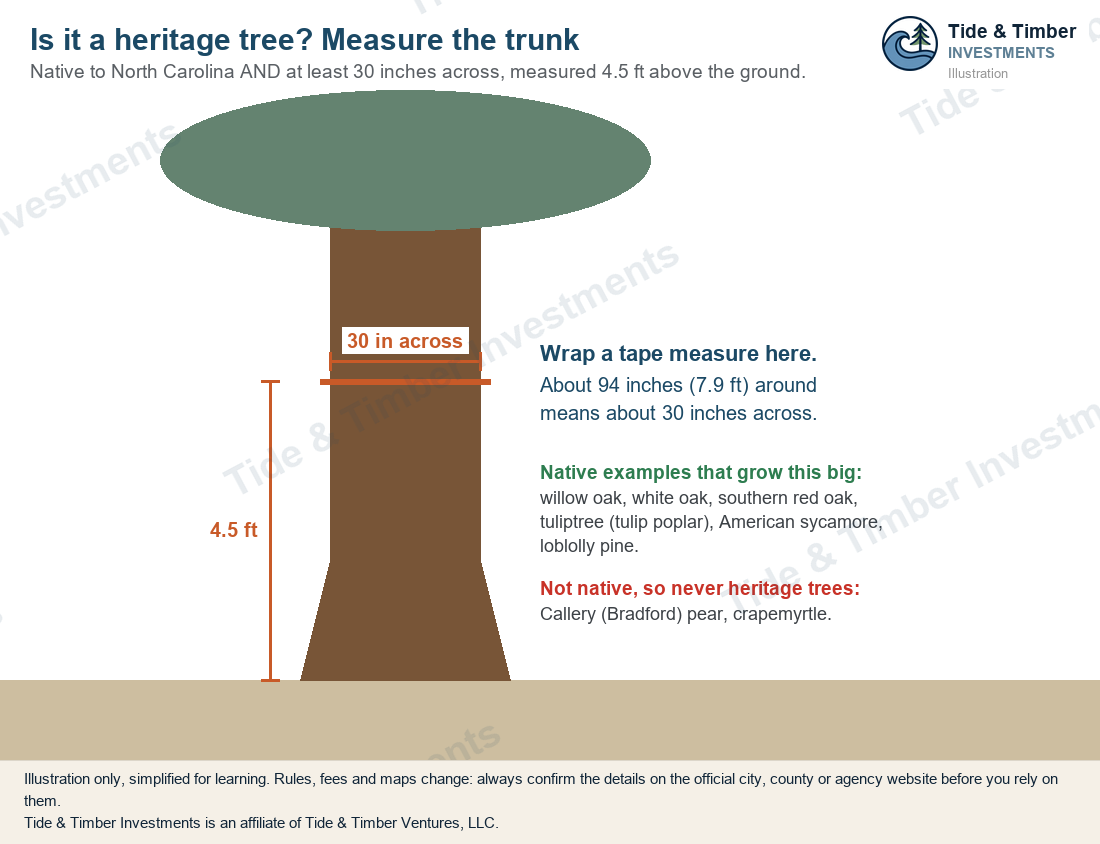
The UDO defines a heritage tree as a tree native to North Carolina (per the US Department of Agriculture’s plants database) with a diameter at breast height (DBH) of 30 inches or more. As a rough guide, a 30-inch-diameter trunk is about 7.9 feet around.
The UDO measures DBH 4.5 feet above the ground. Native trees in the US Department of Agriculture database that can grow this big include willow oak, white oak, southern red oak, tuliptree (tulip poplar), American sycamore and loblolly pine. Trees brought in from elsewhere, such as Callery (Bradford) pear and crapemyrtle, are never heritage trees, however big they get.
What the rules say, in short:
Heritage trees must be protected to the greatest extent possible.
Removing one needs a city tree work permit. An approved development plan counts as one. Permits are granted only in set cases, such as a documented conflict with a building or required street, or where keeping the tree would unreasonably restrict use of the property.
Removal for those reasons requires mitigation: planting one replacement tree on the property and paying a heritage tree mitigation payment set by City Council. Preserving a qualifying large specimen tree can count instead.
Trees that are an imminent hazard or in extreme poor health can be removed without mitigation, with the documentation or no-cost permit the UDO describes, often involving an ISA-certified arborist.
Removing a heritage tree, or disturbing its critical root zone, without a permit can bring civil penalties under the Charlotte Tree Manual.
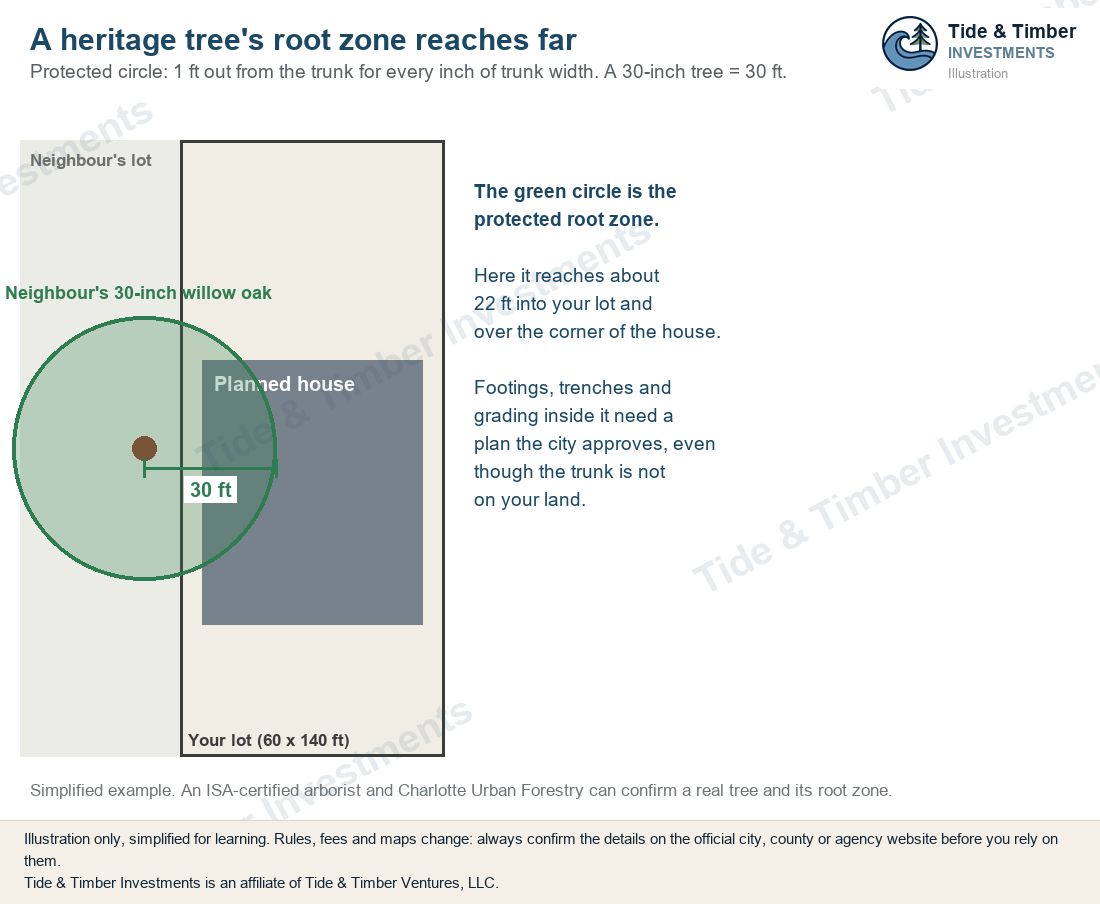
The root zone point matters. A heritage tree near a property line can affect where you dig footings, run utilities or grade, even if the trunk sits safely outside the house footprint.
How far does the root zone reach? The UDO draws it as a circle around the trunk, 1 foot out for every inch of trunk width. A 30-inch heritage tree has a protected circle 30 feet out from the trunk in every direction.
Green area and tree save: does it apply to one house?
What do these terms mean?
Green area is the part of a development site that has to stay planted or wooded. The UDO defines it as land and plants that are "set aside, conserved, or dedicated" under its tree rules (Section 20.15). It can be on the site or, in some cases, somewhere else.
Tree save area is one way to provide green area: a part of the site, measured in square feet, where healthy trees are kept (or replanted) and protected. Think of it as the trees you agree not to cut down.
Payment-in-lieu means paying the city instead of setting the land aside.
As of 21 October 2026, sites subject to the green area rule must provide 15% of the site as green area, using a menu of credits. Tree save areas are one option. Others include planting and payment-in-lieu.
But the UDO exempts the construction of a new single-family home, duplex, triplex or quadraplex as the principal structure on a single lot, unless it is:
part of a new standard or minor subdivision,
built on three or more adjacent lots, or
part of a multi-dwelling development.
The general tree planting requirements in Section 20.17 have the same exemption. So a single infill house on one existing lot usually avoids the 15% green area rule. Split the lot, or build across three lots, and the picture changes. (See Diligence on Lot Splits and Subdivision (coming soon).)
Heritage tree protection has no single-lot exemption. It applies to a single new house too.
Frontage trees: what every new home plants
As of 21 October 2026, a new single-family home, duplex, triplex or quadraplex (outside a subdivision or multi-dwelling development) must plant trees between the house and the street:
One large maturing tree for every 40 feet of lot width, or one small maturing tree for every 30 feet.
At least one tree per lot.
Trees planted in the public street right-of-way must be at least 2-inch caliper.
Existing large shade trees in that front area can count if protected during construction.
Where water meters, sewer lines, driveways or sight lines get in the way, payment-in-lieu or another location may be allowed under the Tree Manual.
Large maturing trees can’t go within 25 feet of overhead power distribution lines, and trees can’t go in transmission line rights-of-way without the utility’s documented approval.
Trees near the street
Because Article 20 also covers trees on City-owned or controlled property, a tree between the sidewalk and the street may not be yours to remove, prune or dig around. On narrow infill lots, a big tree often sits right where you want the driveway. Ask Urban Forestry before you plan around it, and find out early.
A tree checklist for a lot you’re considering
[ ] Walk the lot and note any large trees (a trunk around 8 feet around or more is worth a closer look)
[ ] Note trees near property lines; a neighbour’s heritage tree root zone can still affect your work
[ ] Note trees near the street, especially where the driveway would go
[ ] Decide whether the plan is a single home on a single lot, or a split or subdivision
[ ] Sketch the house, driveway and utility runs over the tree positions
[ ] Ask an ISA-certified arborist about any doubtful trees
[ ] Ask the City of Charlotte Urban Forestry staff before you commit
[ ] Put mitigation payments, replacement trees and frontage trees in the budget
How trees change the numbers
Situation | Likely effect |
|---|---|
Heritage tree in the building area | Redesign, smaller house, or a permit plus mitigation |
Heritage tree near a lot line | Root zone protection limits grading, footings or utilities |
Tree near the street where the driveway goes | Driveway moved, or a city permission process |
Lot split or three-plus lots | Green area (15%) and tree planting rules may apply |
Mature trees you keep | Protection during construction |
Keep reading: Trees are one land rule. Water is another. Floodplains and FEMA Maps in Mecklenburg.
Frequently asked questions
What is a heritage tree in Charlotte?
Under the UDO, a heritage tree is any tree native to North Carolina with a diameter at breast height of 30 inches or more. Heritage trees must be protected as far as possible, and removing one generally needs a city tree work permit and mitigation.
Can I cut down a tree on my own property in Charlotte?
Sometimes, but check first. Under the UDO, heritage trees and trees protected by an earlier development approval need a city tree work permit. Other rules may apply too. Ask the City of Charlotte Urban Forestry staff before removing a large tree, especially before building.
Do I need a tree save area to build one house in Charlotte?
Usually not. As of 21 October 2026, the UDO exempts a new single-family home, duplex, triplex or quadraplex on a single lot from the green area (tree save) rule, unless it’s part of a subdivision, three or more adjacent lots, or a multi-dwelling development. Heritage tree rules and frontage tree planting still apply.
How many trees do I have to plant for a new house in Charlotte?
As of 21 October 2026, the UDO requires one large maturing tree for every 40 feet of lot width, or one small maturing tree for every 30 feet, between the house and the street, with at least one tree per lot. Check the current UDO and Charlotte Tree Manual for details.
What happens if I remove a heritage tree without a permit?
The UDO says owners and others who remove a heritage tree, or disturb its critical root zone, without a tree work permit are subject to civil penalties set out in the Charlotte Tree Manual. Get permission first.
Do Charlotte’s tree rules apply in other Mecklenburg towns?
The UDO’s tree rules apply inside the City of Charlotte and its extraterritorial jurisdiction. Elsewhere, check that town’s own ordinance and planning staff.
Sources
Checked 21 October 2026 at 9:56 PM ET.
City of Charlotte UDO, Article 20, Landscape, Screening and Tree Preservation (Sections 20.13–20.18): charlotteudo.org
City of Charlotte UDO, Article 2, definitions (heritage tree): charlotteudo.org
City of Charlotte, Urban Forestry: charlottenc.gov
Want to go deeper?
This article is part of our Due Diligence series. The companion webinar, A Deal That Dies in Diligence Is Cheap, covers trees alongside the other checks we run before buying a lot.
Join the waitlist for this webinar →
Related reading:
Heritage Trees and Tree Save Requirements (coming soon)
Start Here: A Plain-English Guide to Real Estate Investing in Charlotte
This article is for general education only. It isn’t legal, tax or investment advice, and it isn’t an offer to sell or a solicitation of an offer to buy any security. Any offering by Tide & Timber Investments is made only to persons with whom we have a pre-existing relationship, through formal offering documents. Real estate investing involves risk, including loss of principal. Rules, fees and market conditions change; confirm details with the relevant county, city or town and with your own financial, tax and legal advisers before you act.

