What Goes Into Charlotte Build Costs per Square Foot
By the Tide & Timber Investments team, a veteran-owned residential developer in Charlotte, North Carolina, and an affiliate of Tide & Timber Ventures, LLC. Last updated 21 October 2026.
Quick answer: A Charlotte “build cost per square foot” is the cost of constructing a home divided by its size, but there is no single standard for what goes in the top of that fraction or the bottom. Before you compare any two numbers, find out whether they include site work, fees, utility connections, soft costs and builder profit, and whether the square footage is heated space or everything under the roof. Size, finish level, lot conditions, foundation type and time are what usually move the number most.
Information current as of 21 October 2026, 9:53 PM ET. Rules, fees, maps and market figures change. Anything we could not confirm from an official source has been left out of this article. Check the linked official sources before relying on any detail.
From the market to the land, through Floodplains and FEMA Maps in Mecklenburg, we have been checking whether a lot works. Now we turn to the money: what it costs to build.
You’ll hear it at every meetup and see it in every pro forma: “We build for X dollars a foot.” It sounds precise. It isn’t, or at least not until you know what’s in it.
This article doesn’t give you a Charlotte number. Costs change month to month, and any figure we printed would be out of date or misleading for your project. Instead, it shows you what the number is made of, so you can question it yourself.
What does “cost per square foot” actually measure?
It’s a fraction:
Build cost per square foot = construction cost ÷ square footage
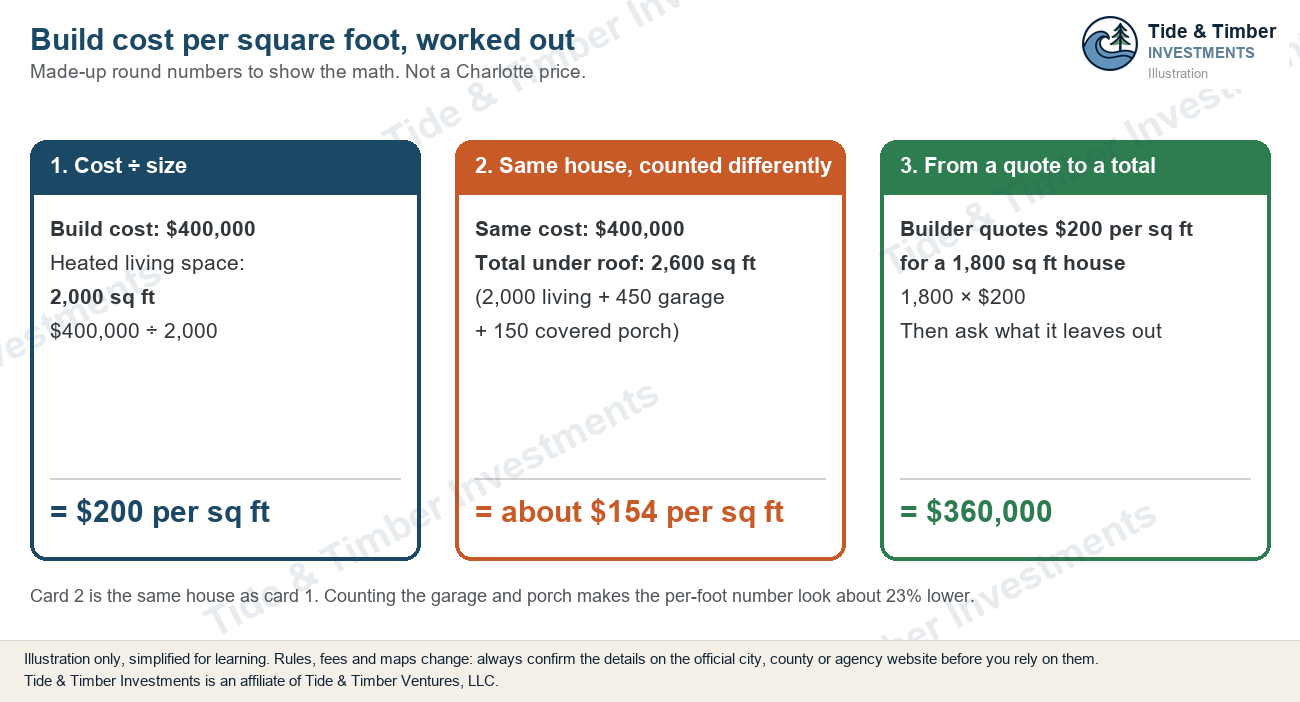
Here's how that works with simple, made-up numbers:
Both halves are flexible.
The top half (cost) might mean only the builder’s contract for the house. Or it might include clearing and grading the lot, demolishing an old house, permit fees, water and sewer connection fees, design, engineering, financing and the builder’s overhead and profit. Two builders can quote the same house at very different “per foot” prices simply because one includes these items and the other doesn’t.
The bottom half (square feet) might be heated living area only, or heated area plus garage, porches and decks. Put a big garage and a wraparound porch into the divisor and the same house suddenly looks cheaper per foot, even though nothing about the cost has changed. Always ask which area was used.
The one-line version: a per-foot number is only comparable to another per-foot number built the same way.
What goes into the cost?
The National Association of Home Builders (NAHB) surveys builders about what it costs to build a single-family home. Its survey for 2024, published in January 2025, breaks construction cost into eight stages. These are national averages from a third-party survey, not Charlotte figures and not ours, but they’re a useful map of where money goes. As of 21 October 2026, this is the edition we found.
Stage | Share of construction cost (NAHB 2024, national) | What it typically covers |
|---|---|---|
Interior finishes | 24.1% | Cabinets, counters, flooring, trim, paint, appliances, fixtures |
Major system rough-ins | 19.2% | Plumbing, electrical, HVAC before walls are closed |
Framing | 16.6% | Wall, floor and roof structure |
Exterior finishes | 13.4% | Siding, roofing, windows, exterior doors |
Foundations | 10.5% | Excavation, footings, foundation walls, slab or crawlspace |
Site work | 7.6% | Preparing the site before building |
Final steps | 6.5% | Landscaping, driveway, clean-up |
Other | 2.1% | Everything that doesn’t fit above |
The same survey found that, on average, construction cost made up 64.4% of a new home’s sale price, the finished lot 13.7%, and builder profit 11.0%. Again, these are national averages. NAHB’s own report explains exactly what sits in each stage, so read it before comparing a local budget with these shares.
What the table shows: finishes and systems are almost half the cost. That’s why two houses of the same size can cost very different amounts. The shell is similar; what goes inside it isn’t.
What usually isn’t in a per-foot figure?
When a builder quotes “per foot”, it often leaves out:
Land. Always separate. (See Land Cost as a Share of Total Project Cost (coming soon).)
Soft costs: design, engineering, surveys, legal, insurance, loan interest and fees. (See Hard Costs vs. Soft Costs Explained (coming soon).)
Demolition of an existing house on an infill lot.
Unusual site work: rock, steep slopes, retaining walls, long driveways, tree protection.
Government and utility fees: building permits, city or town reviews, and Charlotte Water connection and system development fees. These can be a meaningful line on their own. (See Permit and Impact Fees in Charlotte and Mecklenburg and Charlotte Water Capacity and Connection Fees.)
Contingency for surprises. (See Contingency: Why Every Budget Needs a Cushion (coming soon).)
None of these is wrong to exclude. It’s only a problem when you don’t know they’ve been excluded.
What drives the number up or down in Charlotte?
1. Size
Many costs are fixed per house: a kitchen, an HVAC system, a water tap, a permit set, a driveway. Spread across a smaller house, those fixed costs make each foot more expensive. A small infill home can cost more per foot than a large suburban one even if it costs less in total.
2. Finish level
Builder-grade laminate and luxury stone can sit on the same framing. Interior finishes are the largest single stage in the NAHB data, so this is where per-foot numbers spread the most.
3. The lot
An infill lot inside the city can bring work a greenfield subdivision lot doesn’t: tearing down an old house, protecting neighbours’ trees and fences, working around overhead lines, tight access for trucks, and slopes that need retaining walls. Our How to Check a Charlotte Lot on Polaris for Free guide shows how to spot slope, streams and easements before you price anything.
4. Foundation
Slab, crawlspace and basement foundations cost different amounts, and the lot often decides which one you can use. Rock or poor soil found during digging is a common source of overruns.
5. Shape and storeys
A simple box is cheaper to build than a house with many corners, roof lines and bump-outs. Building up (two storeys) usually costs less per foot than building out, because the roof and foundation serve twice the floor area.
6. Attached vs. detached
Charlotte’s Unified Development Ordinance (UDO) allows more than one home on some lots. Shared walls, one foundation and one roof can change the per-unit cost compared with separate houses, while fire separation and separate utilities add cost back. Each design needs its own numbers, and the current UDO decides what’s allowed on a given lot.
7. Labour and materials
When the local building market is busy, skilled trades are harder to book. Lumber, copper, concrete and HVAC equipment prices move with national markets. A per-foot figure from two years ago may not reflect today.
8. Time
Every month a build runs long adds loan interest, insurance and site costs, and leaves the project exposed to price changes. A cheap per-foot number on a slow schedule can cost more than a higher one delivered on time. (See Timeline Assumptions: Why Days Matter as Much as Dollars (coming soon).)
How should you question the build cost line in a pro forma?
Use this checklist whenever someone shows you a per-foot number.
Question | Why it matters |
|---|---|
Is the square footage heated area or total under roof? | Changes the result by a wide margin |
Does the cost include site work and demolition? | Infill lots often need both |
Are permits and Charlotte Water fees included? | Often a separate line, sometimes missing |
Are soft costs and financing included? | Usually not in a builder’s per-foot quote |
Is builder overhead and profit included? | Matters if the sponsor is also the builder |
Is it based on a signed bid or an estimate? | Bids are firmer than rules of thumb |
How old is the number? | Prices move; ask when it was priced |
What does it compare to? | Ask for the sponsor’s past budgets vs. actual costs |
Two terms from that list:
Heated area is the living space you heat and cool. Total under roof adds everything else the roof covers, such as a garage, a covered porch or a covered deck. The same house has a bigger "total under roof" number, so its cost per square foot looks lower.
Soft costs are the costs that aren't materials or labour: design, engineering, surveys, permits, insurance, loan interest and legal fees.
A sponsor is the company or person that finds the project, runs it and raises money from investors to pay for it. A good sponsor will answer every one of these without hesitation. If the answer is "it's just our standard number", ask what's in it.
Why not just use a published Charlotte average?
Published “cost to build in Charlotte” figures from websites and calculators are a starting point at best. They rarely say what’s included, what size or finish they assume, or when they were priced. Some leave out builder overhead. Treat any average as a question to ask, not an answer to rely on. A real budget comes from plans, a specific lot and current bids.
Keep reading: Some costs arrive before construction even starts. Permit and Impact Fees in Charlotte and Mecklenburg.
Frequently asked questions
How much does it cost per square foot to build a house in Charlotte?
It depends on what’s included, the house size, finish level, lot conditions and when it’s priced. Rather than rely on a single average, ask what a quoted number includes (site work, fees, soft costs, profit) and whether it’s per heated foot or total area, then compare it with current local bids.
Why do small houses cost more per square foot?
Many costs are fixed per house, such as the kitchen, HVAC, utility connections, permits and the driveway. Spreading those over fewer square feet raises the cost of each foot, even when the total cost is lower.
Does build cost per square foot include the land?
Usually not. Land is normally a separate line in a pro forma. Always confirm, because a figure that quietly includes land can’t be compared with one that doesn’t.
Are permit and water connection fees part of construction cost?
Sometimes. Some builders include permits and Charlotte Water fees in their price; others list them separately or leave them to the owner. Ask for them as a separate line so you can check them against the current official schedules.
What’s the difference between hard costs and soft costs?
Hard costs are the physical building: materials, labour and site work. Soft costs are everything else needed to get it built and sold, such as design, engineering, permits, insurance, interest and legal fees. A per-foot build figure usually covers hard costs only.
Sources
Checked 21 October 2026 at 9:53 PM ET.
National Association of Home Builders, Cost of Constructing a Home in 2024 (national survey, published 23 January 2025): eyeonhousing.org
City of Charlotte, Unified Development Ordinance: charlotteudo.org
Charlotte Water, Rates & Fees: charlottenc.gov/water/Rates
Want to go deeper?
This article is part of our Reading a Pro Forma series. The companion webinar, Reading a Pro Forma Like an Operator, walks through each line of a development budget and the questions to ask about it. Start with the main guide, How to Read a Development Pro Forma, Line by Line (coming soon), or go back to Start Here: A Plain-English Guide to Real Estate Investing in Charlotte.
Join the waitlist for this webinar →
This article is for general education only. It isn’t legal, tax or investment advice, and it isn’t an offer to sell or a solicitation of an offer to buy any security. Any offering by Tide & Timber Investments is made only to persons with whom we have a pre-existing relationship, through formal offering documents. Real estate investing involves risk, including loss of principal. Rules, fees and market conditions change; confirm details with the relevant county, city or town and with your own financial, tax and legal advisers before you act.

